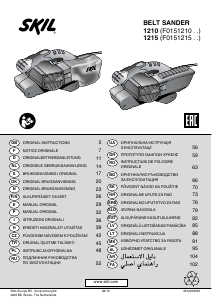
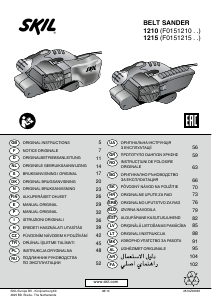
Instrukcja Skil 1210 AA Szlifierka taśmowa

Potrzebujesz instrukcji dla swojego Skil 1210 AA Szlifierka taśmowa? Poniżej możesz bezpłatnie obejrzeć i pobrać instrukcję w formacie PDF w języku polskim. Ten produkt ma obecnie zadane 4 pytania, 0 komentarzy i 0 głosów. Jeśli nie jest to podręcznik, którego szukasz, skontaktuj się z nami.

Czy Twój produkt nie działa, a w instrukcji obsługi brakuje rozwiązania Twojego problemu? Udaj się do Repair Café, gdzie naprawisz swój sprzęt za darmo.

Instrukcja

Loading…

5

Belt sander 1210/1215
INTRODUCTION
This tool is intended for dry sanding with high removal
performance of wood, plastic, metal, ller and painted
surfaces
This tool is not intended for professional use
Read and save this instruction manual 3
TECHNICAL DATA 1
TOOL ELEMENTS 2
A On/o switch
B Knob for locking on/o switch
C Lever for changing sanding belt
D Arrow
E Screw for adjusting belt centering
F Dust bag
G Dust box
H Vacuum cleaner adapter
J Ventilation slots
K Sanding frame
SAFETY
GENERAL SAFETY INSTRUCTIONS
WARNING! Read all safety warnings and all
instructions. Failure to follow the warnings and instructions
may result in electric shock, fire and/or serious injury. Save
all warnings and instructions for future reference. The
term “power tool” in the warnings refers to your mains-
operated (corded) power tool or battery-operated (cordless)
power tool.
1) WORK AREA SAFETY
a) Keep work area clean and well lit. Cluttered or dark
areas invite accidents.
b) Do not operate power tools in explosive
atmospheres, such as in the presence of flammable
liquids, gases or dust. Power tools create sparks which
may ignite the dust or fumes.
c) Keep children and bystanders away while operating
a power tool. Distractions can cause you to lose control.
2) ELECTRICAL SAFETY
a) Power tool plugs must match the outlet. Never
modify the plug in any way. Do not use any adapter
plugs with earthed (grounded) power tools.
Unmodied plugs and matching outlets will reduce risk of
electric shock.
b) Avoid body contact with earthed or grounded
surfaces such as pipes, radiators, ranges and
refrigerators. There is an increased risk of electric
shock if your body is earthed or grounded.
c) Do not expose power tools to rain or wet conditions.
Water entering a power tool will increase the risk of
electric shock.
d) Do not abuse the cord. Never use the cord for
carrying, pulling or unplugging the power tool. Keep
cord away from heat, oil, sharp edges or moving
parts. Damaged or entangled cords increase the risk of
electric shock.
e) When operating a power tool outdoors, use an
extension cord suitable for outdoor use. Use of a
cord suitable for outdoor use reduces the risk of electric
shock.
f) If operating a power tool in a damp location is
unavoidable, use an earth leakage circuit breaker.
Use of an earth leakage circuit breaker reduces the risk
of electric shock.
3) PERSONAL SAFETY
a) Stay alert, watch what you are doing and use
common sense when operating a power tool. Do not
use a power tool while you are tired or under the
influence of drugs, alcohol or medication. A moment
of inattention while operating power tools may result in
serious personal injury.
b) Use personal protective equipment. Always wear
eye protection. Protective equipment such as dust
mask, non-skid safety shoes, hard hat, or hearing
protection used for appropriate conditions will reduce
personal injuries.
c) Prevent unintentional starting. Ensure the switch is
in the off-position before connecting to power
source and/or battery pack, picking up or carrying
the tool. Carrying power tools with your nger on the
switch or energising power tools that have the switch on
invites accidents.
d) Remove any adjusting key or wrench before turning
the power tool on. A wrench or a key left attached to a
rotating part of the power tool may result in personal injury.
e) Do not overreach. Keep proper footing and balance
at all times. This enables better control of the power tool
in unexpected situations.
f) Dress properly. Do not wear loose clothing or
jewelry. Keep your hair, clothing and gloves away
from moving parts. Loose clothes, jewelry or long hair
can be caught in moving parts.
g) If devices are provided for the connection of dust
extraction and collection facilities, ensure these are
connected and properly used. Use of dust collection
can reduce dust-related hazards.
4) POWER TOOL USE AND CARE
a) Do not force the power tool. Use the correct power
tool for your application. The correct power tool will do
the job better and safer at the rate for which it was designed.
b) Do not use the power tool if the switch does not turn
it on and off. Any power tool that cannot be controlled
with the switch is dangerous and must be repaired.
c) Disconnect the plug from the power source and/or
the battery pack from the power tool before making
any adjustments, changing accessories, or storing
power tools. Such preventive safety measures reduce
the risk of starting the power tool accidentally.
d) Store idle power tools out of the reach of children
and do not allow persons unfamiliar with the power
tool or these instructions to operate the power tool.
Power tools are dangerous in the hands of untrained
users.
Pobierz instrukcję w języku polskim (PDF, 6.83 MB)
(Apelujemy o dbanie o środowisko i drukowanie instrukcji tylko wtedy, gdy jest to niezbędne)

Loading…

Ocena

Podziel się z nami swoją opinią na temat Skil 1210 AA Szlifierka taśmowa i oceń urządzenie. Chcesz podzielić się swoimi doświadczeniami z tym produktem lub zadać pytanie? Zostaw komentarz na dole strony.
Czy jesteś zadowolony z Skil 1210 AA Szlifierka taśmowa?
Tak Nie
Zostań pierwszą osobą, która oceni ten produkt
0 głosów

Dołącz do dyskusji na temat tego produktu

Tutaj możesz podzielić się swoją opinią na temat Skil 1210 AA Szlifierka taśmowa. Jeśli masz pytanie, najpierw dokładnie przeczytaj instrukcję. Zapytanie o instrukcję można złożyć za pomocą naszego formularza kontaktowego.

Więcej o tej instrukcji

Rozumiemy, że miło jest mieć papierową instrukcję obsługi Skil 1210 AA Szlifierka taśmowa. Zawsze możesz pobrać instrukcję z naszej strony internetowej i wydrukować ją samodzielnie. Jeśli chcesz otrzymać oryginalną instrukcję, zalecamy skontaktowanie się z Skil. Być może będą w stanie dostarczyć oryginalną instrukcję. Szukasz instrukcji swojego Skil 1210 AA Szlifierka taśmowa w innym języku? Wybierz preferowany język na naszej stronie głównej i wyszukaj numer modelu, aby sprawdzić, czy jest on dostępny.

Dane techniczne

Marka Skil
Model 1210 AA
Kategoria Szlifierki taśmowe
Typ pliku PDF
Rozmiar pliku 6.83 MB

Wszystkie podręczniki dla Skil Szlifierki taśmowe
Więcej podręczników Szlifierki taśmowe

Często zadawane pytania dotyczące Skil 1210 AA Szlifierka taśmowa

Nasz zespół wyszukuje przydatne informacje na temat produktu i udziela odpowiedzi na często zadawane pytania. Jeśli znajdziesz nieścisłości lub błędy w naszych odpowiedziach na pytania, poinformuj nas o tym przy pomocy naszego formularza kontaktowego.

Czy podczas korzystania ze szlifierki muszę nosić ochronniki słuchu? Zweryfikowany

Tak, powinieneś. Chociaż poziom hałasu wytwarzanego przez szlifierkę może się różnić w zależności od marki i modelu, długotrwałe narażenie na głośny hałas może spowodować trwałe uszkodzenie słuchu. Dlatego dobrze jest nosić ochronniki słuchu.

To było pomocne (23) Czytaj więcej

Czy podczas używania szlifierki muszę nosić okulary ochronne? Zweryfikowany

Tak. Podczas szlifowania drobne cząstki mogą unosić się w górę. Kiedy uderzą w oko, mogą spowodować trwałe uszkodzenie oczu. Dlatego zawsze należy nosić okulary ochronne.

To było pomocne (16) Czytaj więcej

Czy podczas korzystania ze szlifierki muszę nosić maskę przeciwpyłową? Zweryfikowany

Tak. Podczas szlifowania wydziela się pył, który może spowodować uszkodzenie dróg oddechowych. Niektóre powierzchnie mogą również uwalniać chemikalia, takie jak farba lub lakier podczas szlifowania. To także dobry powód do noszenia maski przeciwpyłowej.

To było pomocne (15) Czytaj więcej

Czy mogę przechowywać elektronarzędzia w szopie lub garażu? Zweryfikowany

Ogólnie rzecz biorąc, elektronarzędzia można przechowywać w szopie lub garażu, nawet jeśli czasami tam zamarza. Jednak dla żywotności elektronarzędzia lepiej jest przechowywać je w suchym miejscu, bez większych wahań temperatury. W szopie lub garażu różnice temperatur mogą powodować kondensację, która może powodować rdzę. Ponadto narzędzia zasilane akumulatorami działają krócej i nie ładują się tak dobrze w bardzo niskich temperaturach. Aby mieć pewność, w jaki sposób elektronarzędzie powinno być przechowywane, zawsze dokładnie przeczytaj instrukcję obsługi.

To było pomocne (10) Czytaj więcej
Instrukcja Skil 1210 AA Szlifierka taśmowa

Produkty powiązane

Powiązane kategorie

×
Download